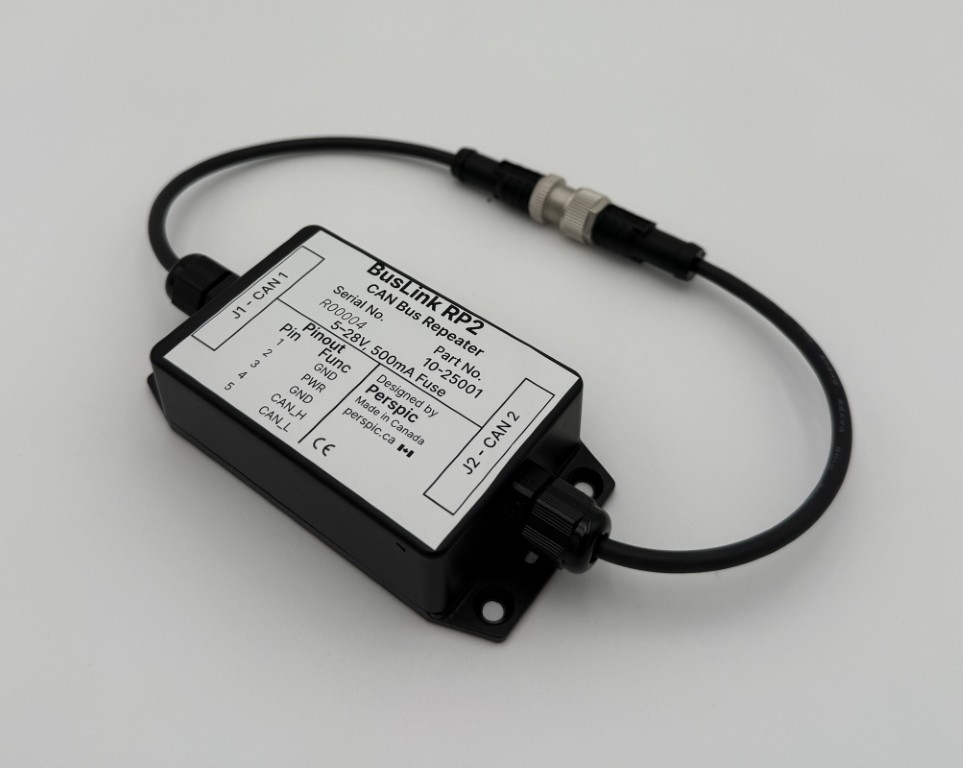
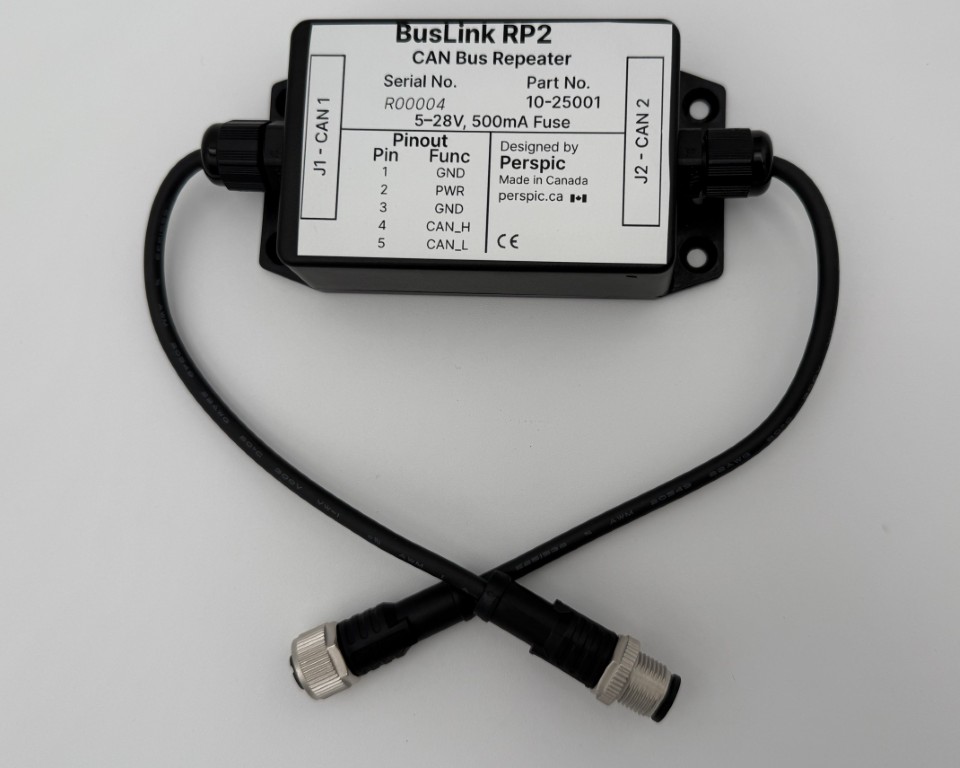
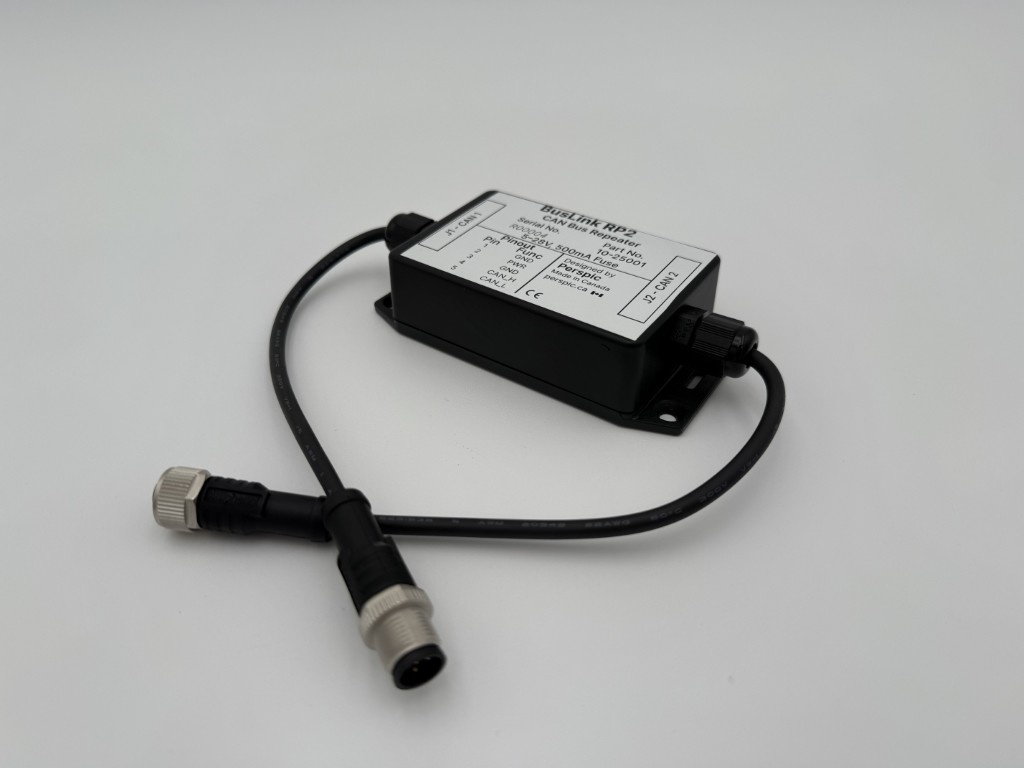
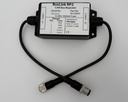
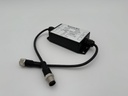
Rugged CAN Bus Repeater for Industrial and Automotive Applications
Extend and bridge your CAN Bus networks with the BusLink CR2, a durable 2-channel CAN repeater designed for mission-critical applications. Whether you're working with J1939, CANopen, or proprietary CAN systems, this module provides transparent message relay between two independent CAN networks—with full baud rate conversion, ID filtering, and fault isolation built in.
Engineered for industrial automation, off-highway equipment, mining vehicles, and wind turbine systems, the BusLink CR2 is your solution for network extension, segmentation, and protocol bridging in demanding environments.
Key Features
- 2-channel CAN Bus repeater with independent baud rate configuration
- Supports CAN baud rates from 5 kbit/s to 1 Mbit/s
- Baud rate conversion between mismatched networks
- Up to 128 standard (11-bit) and 64 extended (29-bit) filters per bus
- Wide input voltage range: 5 to 28 V DC
- Fused power distribution between CAN networks (2A)
- Standard 120 Ohm termination resistors with optional cut traces
- IP54 rugged enclosure standard; IP68 available for full submersion
- M12 5-pin connectors or Deutsch/Amphenol options
- USB-C configuration via console or JSON
- GVRET compatible for live traffic monitoring with SavvyCAN
- ESD and reverse polarity protection
- 25 µs relay latency
- Operating temperature: -20°C to +80°C (IP54) or -40°C to +85°C (IP68)
Applications
- Baud rate bridging between legacy and modern CAN devices
- Network isolation to protect sensitive control modules from noisy subsystems
- CAN ID filtering to reduce bus congestion and improve determinism
- Harsh industrial environments: mining, forestry, agriculture, wind energy
- Vehicle prototyping and development requiring multi-bus architectures
- Data acquisition and diagnostics via USB interface
- Segment bridging and CAN Bus topology extension
- Mixed-speed networks in J1939, CANopen, or proprietary systems
Why Use a CAN Repeater?
As CAN networks grow in complexity, challenges arise: legacy devices running at different baud rates, noisy subsystems causing bus errors, and congested networks slowing critical communications. The BusLink CR2 solves these problems by acting as an intelligent bridge between network segments.
Unlike a simple isolator, the CR2 actively translates between baud rates, filters unwanted traffic, and prevents faults on one bus from propagating to the other. If one side experiences errors, the CR2 automatically degrades to protect the healthy network—then recovers once conditions improve.
Frequently Asked Questions (FAQ)
Q: Can this repeater bridge networks running at different speeds?
A: Yes. Each bus is independently configurable from 5 kbit/s to 1 Mbit/s, allowing you to connect a 125 kbit/s sensor network to a 500 kbit/s control bus seamlessly.
Q: What happens if one CAN bus has errors?
A: The CR2 automatically detects protocol errors and progressively limits activity on the affected bus—from disabling retransmits to entering listen-only mode—while keeping the other bus operational. Recovery is automatic once the fault clears.
Q: Can I filter which messages pass between networks?
A: Yes. You can configure up to 128 standard and 64 extended filters per bus using range, dual-ID, or mask-based filtering. Accept or reject specific CAN IDs to control exactly what traffic crosses between networks.
Q: How do I configure the device?
A: Connect via USB-C and use a terminal program (PuTTY, Tera Term) to access the command console. Configuration can also be imported/exported as JSON.
Q: Can I use this as a CAN-to-PC interface?
A: Yes. The CR2 supports GVRET protocol, making it compatible with SavvyCAN for live traffic monitoring, logging, and analysis.
Q: How do I disable termination resistors?
A: Cut the solder jumpers on the PCB as outlined in the user manual. Re-enable by bridging with solder.
Q: Is the device waterproof?
A: IP54 is standard (splash-resistant). IP68 is available for applications requiring full submersion resistance.